
Wastewater in Meat Processing
Innovation leads to cost-cutting and efficient production in meat processing operations.
The Challenge
Background
Meat processing is a water-intensive operation. For every ton of meat produced, up to 6,250 liters of wastewater containing high levels of total suspended solids and organics is generated.
Wastewater treatment poses a significant impact on the total cost of operations. Meat processors are looking for innovative ways to improve their wastewater treatment performance and lower their overall operating costs while increasing their personnel efficiency.
Opportunity
An Australian small goods meat production facility had an opportunity to increase production by 15% due to increased demand. To successfully capitalize on this opportunity, they had to first address the issues with their wastewater treatment.
Their DAF had become a production bottleneck due to wastewater flow rates continually reaching or exceeding their permitted discharge limits.
Key Challenges
- DAF performance becoming a production bottleneck with flow rates exceeding permitted discharge limits
- Inexperienced personnel conducting manual processes resulting in mis-dosing and stock management issues
- Significant internal pressure on WWTP operators to improve overall operations
- Need to increase production while maintaining compliance with local discharge regulations
Solution Objectives
- Improve DAF contaminant removal efficiency and consistency to benefit production
- Reduce operator oversight while minimizing need for local onsite waste treatment expertise
- Minimize DAF operating costs to boost overall profitability
- Decrease wastewater volume while staying in compliance with local discharge requirements
Streamwise D.I.™ Impact
Significant improvements in system performance and cost reduction, even with 15% production increase
DAF Performance Improvement
Key performance metrics comparison: Existing vs Streamwise D.I.™ control
Performance Metrics Breakdown
Detailed view of improvements across all measured parameters
Cost Savings Breakdown
Annualised TCO savings across all operational categories
Detailed Cost Impact Analysis
Line-by-line comparison showing savings in each category
Process Optimization
Key Discovery
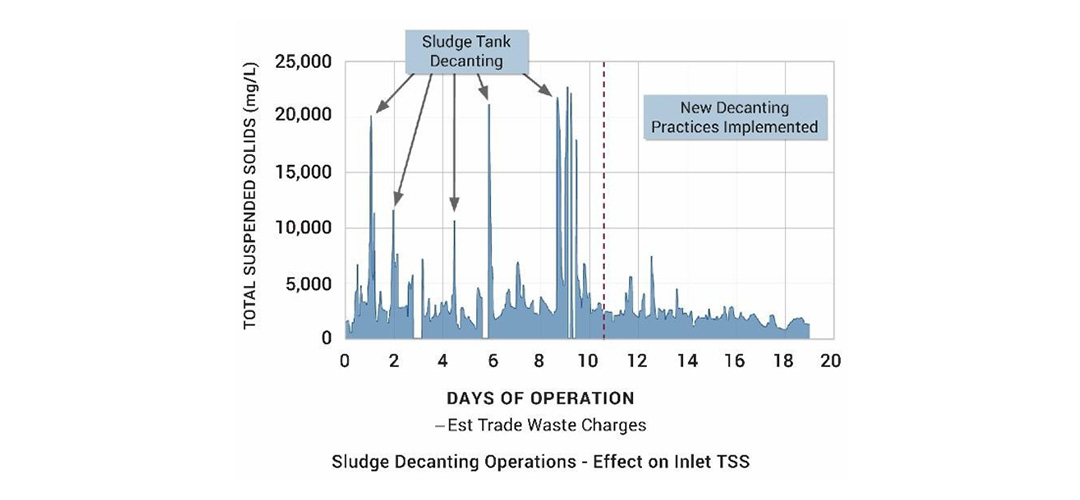
Soon after start-up of the Streamwise D.I.™ unit, we discovered high TSS spikes in the influent water to the DAF. Working with the local operators and Environmental Manager, the source of the TSS spikes was traced to sludge tank decanting practices resulting in sludge being drained back into the DAF each time the decanting operation was performed, resulting in significant plant upsets.
Solution: Better decanting practices were implemented, eliminating the high TSS spikes, lowering polymer usage, and reducing average effluent TSS.
Sludge Decanting Operations - Effect on Inlet TSS
Impact of improved decanting practices on total suspended solids levels over time
Key Insight: The graph clearly shows dramatic TSS spikes during sludge tank decanting operations (days 0-10), followed by stable, significantly lower TSS levels after implementing new decanting practices (days 12-20). This optimization alone contributed to reduced polymer usage and improved DAF performance.
Benefits Achieved
- Increased production capacity by 15%
- Improved DAF contaminant removal efficiency
- Reduced operator involvement and workload
- Enhanced operational visibility and control
- Lower cost and more efficient wastewater processing
Future Opportunities
- More efficient DAF operations support future water reuse initiatives
- Enhanced water recycling capabilities
- Continued optimization through AI learning
- Scalable solution for facility expansion
The Streamwise D.I.™ Solution:
Streamwise D.I.™ technology for DAF is helping an Australian small goods meat processor significantly improve its waste treatment operations through:
– Robust online sensors
– Proprietary AI based chemical control
– 24/7 performance monitoring, alarm notification and expert oversite
Background
Meat processing is a water-intensive operation. For every ton of meat produced, up to 6,250 liters of wastewater containing high levels of total suspended solids and organics, is generated.
Wastewater treatment poses a significant impact on the total cost of operations.
Meat processors are looking for innovative ways to improve their wastewater treatment performance and lower their overall operating costs while increasing their personnel efficiency.
Opportunities
An Australian small goods meat production facility processes on average 38 tons of ham per day for local market consumption and had an opportunity to increase production due to increased demand. To successfully capitalize on this opportunity, they had to first address the issues with their wastewater treatment.
Their DAF had become a production bottleneck due to wastewater flow rates continually reaching or exceeding their permitted discharge limits.
This, combined with inexperienced personnel conducting manual processes that resulted in mis-dosing and mismanaging stock supply, meant that the WWTP operators were facing significant internal pressure to improve overall operations.
This plant needed effective and efficient ways to optimize and automate wastewater treatment operations. So, management consulted us on using Streamwise D.I.™ technology to help the plant:
1. Improve DAF contaminant removal efficiency and consistency, benefiting production while decreasing wastewater volume and staying in compliance with local discharge
2. Reduce operator oversight while minimizing the need for local onsite waste treatment expertise.
3. Minimize DAF operating costs boosting overall
Soon after the start-up of the Streamwise D.I.™ unit, we discovered high TSS spikes in the influent water to the DAF. Working with the local operators and Environmental Manager, the source of the TSS spikes was traced to sludge tank decanting practices resulting in sludge being drained back into the DAF each time the decanting operation was performed, resulting in significant plant upsets. Better decanting practices were implemented eliminating the high TSS spikes, lowering polymer usage and reducing average effluent TSS.
Streamwise D.I. Results™
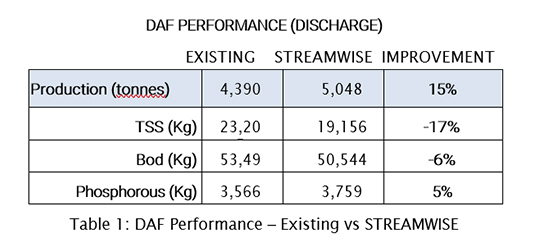
Table 1
In Table 1, we see the improvement in DAF operation from Existing to Streamwise D.I.™ control.
Streamwise D.I.™ control improved system performance by removing more contaminants at the DAF and sending less total TSS and BOD to the local water authority, even while production increased by 15%.
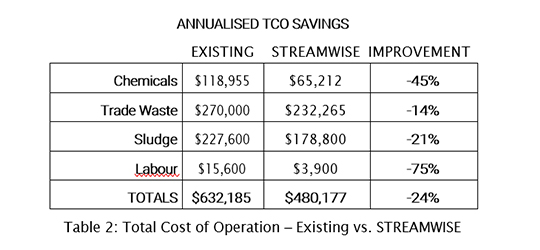
Table 2
In Table 2, we see the effect of Streamwise D.I.™’s proprietary control vs manual control on the sites total cost of operation. Streamwise D.I.™ control provided a significant reduction in chemical costs of 45% even while production increased by 15%. The Streamwise D.I.™ system will reduce overall costs by 24% and save this meat processor and estimated $152,000 per year.
Streamwise D.I.™ for DAF technology-assisted this meat processing plant to increase production and be able to process wastewater at a lower cost and more efficiently than ever before.
All of this was achieved while reducing operator involvement and increasing operational visibility. In addition, more efficient and consistent DAF operations will support future water reuse and recycling efforts.
Get more from Streamwise D.I.™
Request demo
Like to see Streamwise D.I.™ in action? Please contact us to arrange a demonstration.
Request information pack
Like to learn more about how Streamwise D.I.™ can save you money? Please contact us for an information pack.
Stay in touch
Like to keep in touch with us? Please sign up for our newsletter.